
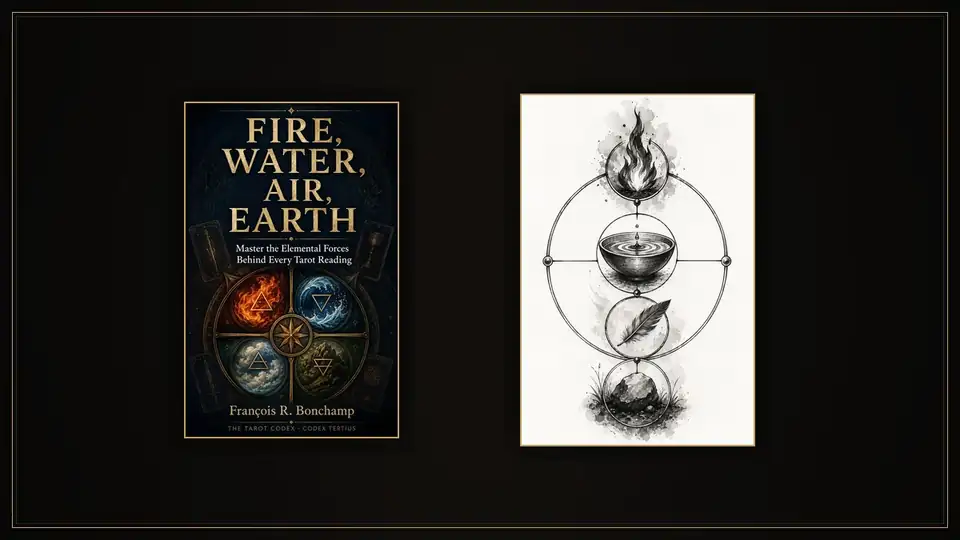
Behind every symbol, gesture, and historical reference in the tarot deck lies an ancient cosmological engine: the four classical elements of Fire, Water, Air, and Earth. While modern psychology speaks of motivation, feeling, cognitive framing, and somatic embodiment, the Western esoteric tradition mapped these identical human realities through the elemental temperaments. When you pick up a tarot deck, you are not merely handling pieces of printed cardboard; you are holding an elemental laboratory.
In The Tarot Codex, Codex III, Fire, Water, Air, Earth, establishes that the suits are not decorative categories. They are the four primary modes through which consciousness engages with existence. Before you examine whether a card is a Six or an Eight, you must first perceive its elemental atmosphere. What is the weather of the spread? Is it arid and burning, drenched and overflowing, stormy and sharp, or rooted in heavy clay?
The Four Elemental Realms
1. Fire (The Suit of Wands): Will, Desire, and Ignition
Fire is radiant, upward-moving, volatile, and transformative. It represents the life force, ambition, primal passion, creative sparks, and the courage to assert one's identity. Fire does not wait; it demands fuel, oxygen, and direction. In a reading, Fire shows where a person feels compelled to act, take risks, or defend their territory.
- Healthy Fire: Charisma, infectious enthusiasm, leadership, creative breakthrough, decisive initiative.
- Excess Fire: Burnout, impulsive aggression, rage, arrogance, inability to sustain routine.
- Deficient Fire: Lethargy, apathy, hesitation, dread of visibility, lack of self-belief.
2. Water (The Suit of Cups): Feeling, Connection, and Memory
Water is receptive, downward-seeking, fluid, and absorbing. It takes the shape of whatever vessel holds it. Water governs the interior landscape: romantic bonds, grief, nostalgia, spiritual devotion, intuitive depths, and unconscious longing. While Fire acts upon the world, Water allows the world to resonate within.
- Healthy Water: Genuine empathy, emotional resilience, intimacy, authentic creative imagination, forgiveness.
- Excess Water: Emotional flooding, codependency, victimhood, drowning in past sorrow, escapism into fantasy.
- Deficient Water: Emotional coldness, cynicism, transactional relationships, inability to grieve or connect.
3. Air (The Suit of Swords): Thought, Discernment, and Boundary
Air is invisible, pervasive, fast, and clarifying. It is the breath of speech, the razor of analysis, and the architect of concepts. Swords cut through confusion to establish objective truth, but that same sharp edge can sever relationships and inflict psychological wounds. Air asks what is true, regardless of how it feels.
- Healthy Air: Intellectual rigor, clear communication, sound judgment, healthy personal boundaries, ethical clarity.
- Excess Air: Chronic overthinking, debilitating anxiety, verbal cruelty, hyper-rationalizing away emotions.
- Deficient Air: Confusion, gullibility, lack of mental discipline, inability to articulate one's position.
4. Earth (The Suit of Pentacles): Body, Resource, and Manifestation
Earth is dense, tactile, slow, and enduring. It is the soil beneath our feet, the flesh of our bones, the money in our ledger, and the physical artifacts of craft. Earth is concerned with what can be built, measured, repaired, and sustained across generations. It anchors the fiery idea, the watery longing, and the airy strategy into concrete reality.
- Healthy Earth: Practical competence, financial prudence, bodily vitality, dependable craftsmanship, patience.
- Excess Earth: Greedy hoarding, stubborn rigidity, materialism, dread of spiritual or conceptual change.
- Deficient Earth: Impracticality, chronic financial instability, neglect of health, ideas that never take form.
Elemental Interactions: Harmony and Conflict
When cards lie beside each other in a spread, their elements interact according to classical physical laws:
- Active Pairs (Fire and Air): Fast, outward-facing, conceptual, and dynamic. Air fans Fire into a roaring flame, while Fire heats Air into upward drafts. Spreads dominated by these two elements describe fast-moving, high-intensity situations requiring intellectual agility and bold action.
- Passive/Receptive Pairs (Water and Earth): Slow, nurturing, stabilizing, and reflective. Water irrigates Earth to produce organic growth; Earth provides the riverbank that gives Water direction and form. Spreads with this combination point to domestic stability, healing, deep creative incubation, and long-term consolidation.
- Oppositional Pairs: Fire vs. Water produces steam and extinguishing—emotional needs extinguish passionate ambition, or raw anger boils away vulnerability. Air vs. Earth produces friction—abstract ideals clash with cold physical constraints, or mundane bureaucracy smothers intellectual vision.
How to Diagnose Spread Weather in Three Steps
- Count the suits: In a five-card spread, note the tally of Wands, Cups, Swords, and Pentacles. If three or more belong to one element, that element dictates the overarching crisis or opportunity.
- Scan for missing elements: If zero Cups appear in a reading about a marriage, the omission is the most important clue—the relationship is being handled with contracts (Swords) or money (Pentacles), while emotional intimacy has vanished.
- Look at the Major Arcana: When a Major Arcana card appears, identify its elemental correspondence to see how archetypal forces are reinforcing or correcting the suit weather.
Elemental weather is legible in one card as readily as in ten. Every result in our free yes/no tarot reading names the element of the card drawn, which lets you check the register of the answer at a glance: a Yes delivered in Cups concerns feeling, a Yes delivered in Pentacles concerns resources, and confusing the two produces advice that is technically correct and practically useless.