
A common mistake among tarot readers is treating symbols as rigid code words: a dog always means "loyalty," a pomegranate always means "fertility," a mountain always means "an obstacle." This dictionary mentality reduces the rich, multi-layered visual iconography of the Rider-Waite-Smith deck into a simplistic rebus puzzle. When real readings unfold, rigid symbol definitions inevitably produce shallow or contradictory readings.
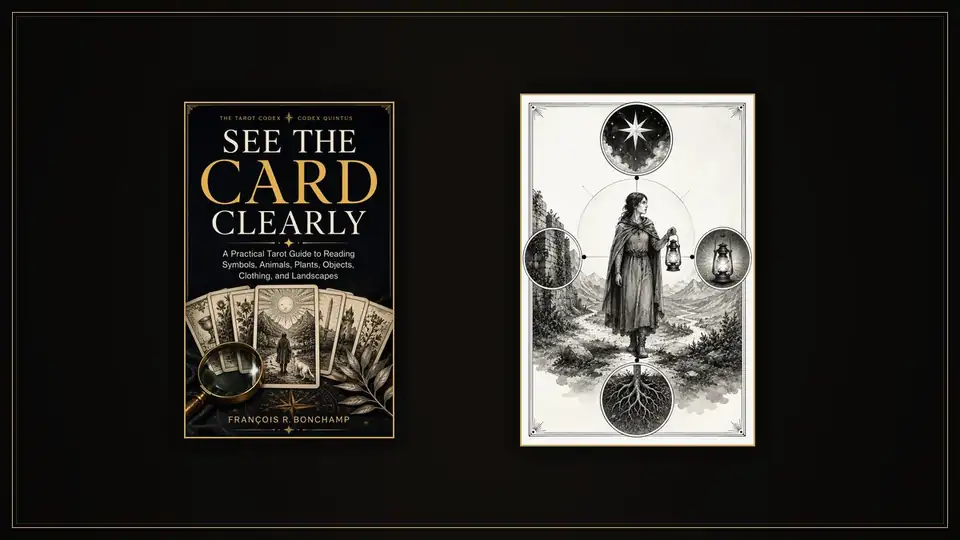
In The Tarot Codex, particularly throughout Codex V, See the Card Clearly, we present a disciplined alternative: tarot symbols are visual fields of possibility. Their exact interpretive pressure changes dynamically based on three decisive factors: where the symbol is positioned, what condition it is in, and how it relates to the other elements inside the frame.
The Six Master Families of Tarot Symbolism
To organize the hundreds of visual details found across the seventy-eight cards, we classify tarot symbolism into six distinct semantic families:
1. Landscape and Terrain (The Ground of Being)
The ground a figure stands upon reveals the stability and reality of their situation:
- Mountains: In the distance (such as in the Fool or Eight of Cups), mountains represent enduring challenges, spiritual ascent, and long-range goals. If mountains are jagged and red, the journey demands fiery struggle; if snow-capped, it requires austere clarity.
- Flowing Water (Rivers and Streams): Water signifies unconscious emotional currents, passage of time, and emotional permeability. The river in Death or the stream in the Empress connects conscious earth with deep psychic waters.
- Ploughed Fields: Visible in the Knight of Pentacles and Ten of Wands, furrowed soil indicates human labor, cultivated investment, and the slow laws of agricultural patience.
2. Architecture and Thresholds (Human Structures)
Buildings, pillars, and walls reveal the relationship between human order and natural reality:
- Stone Towers and Castles: Castles represent established security, lineage, and defense. When a tower is struck by lightning (as in the XVI Tower), it marks the violent collapse of artificial ego structures that refused natural evolution.
- Twin Pillars: Present in the High Priestess, Hierophant, and Justice, pillars represent the gateway between dualities (light/dark, conscious/unconscious, mercy/severity). Passing through them marks an initiatory threshold.
- Walls and Gateways: A garden wall (as in the Sun) protects innocence; a stone fortress boundary in the Nine of Pentacles indicates cultivated self-sovereignty and healthy personal boundaries.
3. Flora and Fauna (Nature's Living Agents)
Animals and plants represent instinctual drives and organic life cycles:
- Roses and Lilies: Found together in the Magician and Two of Wands. The red rose embodies passionate, terrestrial desire and blood; the white lily signifies spiritual purity, intellectual clarity, and transcendent intent.
- Dogs and Wolves: In the Fool, the small white dog is instinctual vigilance protecting innocence; in the Moon, the domestic dog and wild wolf represent the tame and untamed aspects of the primal canine psyche baying at unconscious depths.
- Lions and Beasts: In Strength, the red lion represents raw passion, libido, and animal courage. Rather than being slain, the beast is gently stroked, illustrating that instinct must be befriended rather than violently repressed.
4. Regalia and Clothing (Identity, Status, and Protection)
Garments show what identity the figure is wearing in the world:
- Armor: As explored in our dedicated study on armor in tarot cards, metal plate represents psychological defense, emotional bracing, and readiness for conflict.
- Crowns: Heavy gold crowns (as in the Emperor or Four of Pentacles) signify sovereign authority, inherited duty, but also the weight of institutional control.
- Robe Colors: Red robes reveal active worldly will; blue signifies contemplative interiority and wisdom; yellow reflects mental illumination and solar vitality; white denotes unblemished integrity or tabula rasa.
5. Celestial Bodies (Cosmic Cycles)
The sky reveals the overarching metaphysical conditions:
- The Sun: Total consciousness, life-giving truth, visibility, warmth, and vitality where nothing remains obscured.
- The Moon: Reflected light, illusions, biological rhythms, twilight perception, and navigating the unknown by intuition.
- Stars: Cosmic hope, guiding light, serene inspiration, and long-term spiritual orientation following crisis.
6. Implements and Tools
What a figure holds in their hands reveals their immediate capability and agency. A wand held aloft is an antenna for will; a balanced scale weighs truth; an open ledger tracks accounts; a golden key unlocks forbidden knowledge.
The Three Laws of Contextual Symbolism
When decoding any symbol during a reading, apply these three governing laws:
- The Law of Position: A key held firmly in the hand means access and active agency. A key lying discarded on the ground means forgotten capability or lost opportunity. A key hanging around the neck signifies an inherited secret.
- The Law of Condition: A blooming rose indicates vibrant vitality; a withered garland indicates expired passion. A calm lake provides clear reflection; a turbulent sea threatens shipwreck. Condition always modifies essence.
- The Law of Spread Repetition: When the same symbol family appears across multiple cards in a spread (e.g., three cards showing stone walls, or four cards containing flowing water), that symbol is the hidden spine of the reading.