
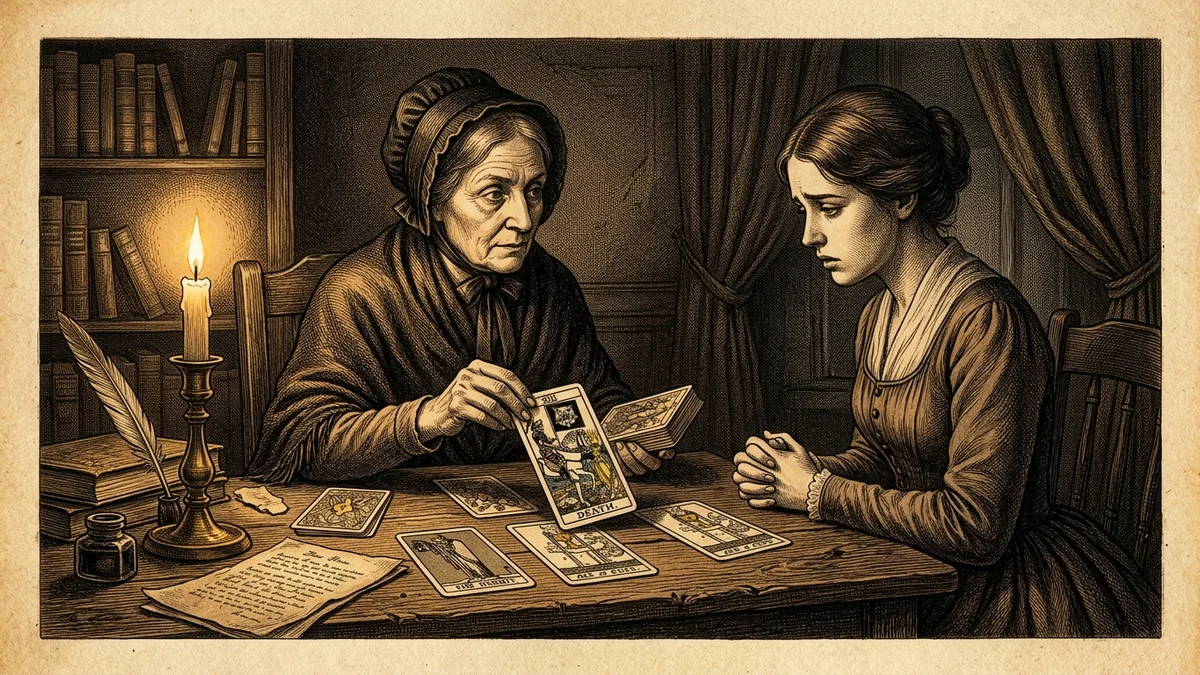
She never saw a single card she turned.
In the opening pages of François R. Bonchamp’s standalone work, Across the Table: Tarot, Charlatans, and the Gift of Reading People, we are introduced to Madame Odile. For thirty years, she has laid cards for clients in a small room above a pharmacy in Lyon. For the last twenty of those years, she has been entirely blind. Her fingers recognize the worn cardboard by touch alone, but what she interprets is not the ink on the cards. What she reads is the human being sitting in the opposite chair: the sudden catch of breath, the rustle of wool as shoulders tense, the half-second delay before an answer, and the unspoken grief carried into the room.
While The Tarot Codex is an extensive ten-volume method dedicated to reading the visible symbols, numbers, elements, and gestures inside the cards, Across the Table steps back to investigate the other half of the reading room: the psychology, the history, the ethics, and the delicate interpersonal dance that takes place between reader and querent.
1. The 300-Year Metamorphosis of Card Reading
Modern practitioners frequently imagine that tarot was handed down through antiquity as an unbroken chain of mystical divination. The historical record tells a far more fascinating and human story.
For its first three centuries—from the illuminated Visconti-Sforza decks of 15th-century Milan and Ferrara onward—tarot was not a prophetic oracle. It was Tarocchi, an intricate trick-taking card game played for cash at Italian courts and taverns. It was not until 1781 that the Swiss-French scholar Antoine Court de Gébelin looked upon a Tarot de Marseille deck for fifteen minutes and boldly proclaimed it to be the sole surviving book of ancient Egyptian priests.
From that pivotal moment of imaginative reinvention, Across the Table charts the cards through every major transformation:
- Jean-Baptiste Alliette (Etteilla): The Paris seed merchant who became the first professional occult cartomancer, assigning divinatory keywords to upright and reversed cards.
- Marie Anne Lenormand: The celebrity sibyl of Napoleonic Paris, whose posthumous deck was derived from a 1799 German parlor dice-game created in Nuremberg.
- The Hermetic Order of the Golden Dawn: Victorian occultists in London and Paris who synthesized tarot with Kabbalah, astrology, and ceremonial magic.
- Pamela Colman Smith: The brilliant Jamaican-influenced artist who illustrated the iconic 78 Rider-Waite-Smith scenes in 1909 for what she described as "very little cash."
- The Modern Era: From kitchen-table Kipper readings to late-night 1-900 phone psychic networks, algorithmic mobile tarot apps, and contemporary artificial intelligence reading engines.
2. The Counterfeiters: Deconstructing the Cold Reading Machine
Wherever human vulnerability, grief, and longing gather, exploiters inevitably follow. A central pillar of Across the Table is an unsparing historical and forensic examination of fortune-telling scams and the mechanics of cold reading.
From the English Witchcraft Act of 1735 to modern wire-fraud prosecutions, charlatans have relied on repeatable psychological vulnerabilities. Bonchamp dissects the notorious "curse-removal swindle" step by step:
- The Diagnosis of Hidden Affliction: Convincing the client that their chronic bad luck or romantic disappointment is not ordinary life, but a targeted generational curse or dark energy.
- The Demarcation of Isolation: Warning the victim never to speak of the reading to family or friends, severing their external reality checks.
- Escalating Financial Purification: Demanding cash, heirloom jewelry, or money orders to be "cleansed," buried in sacred ground, or burned in secret rituals.
Equally critical is the anatomical breakdown of cold reading. Rather than treating cold reading as magical intuition, the book isolates its specific linguistic mechanisms:
- The Barnum (Forer) Effect: Statements that sound intimately personal but apply universally to almost every human being (e.g., "You possess great reserves of unexpressed potential that those around you fail to appreciate.").
- The Rainbow Ruse: Crediting someone with both a trait and its exact opposite simultaneously (e.g., "You are generally quiet and reserved, but when circumstances push you into a corner, you can become remarkably decisive.").
- Shot-Gunning: Rapidly tossing out vague names, initials, or physical conditions until the listener inadvertently volunteers the missing connection.
Why must an ethical, serious reader study these deception techniques? Because without a rigorous understanding of cold reading, even well-intentioned readers can unwittingly deceive themselves and their clients, confusing accidental feedback loops with intuitive insight.
3. The Reader's Craft: A Complete School of Attention
Stripped of supernatural theatre and exploitative trickery, what remains of the reader's art? Bonchamp argues that genuine reading is a disciplined, ethical school of attention, drawing direct methodologies from crisis negotiators, police interrogators, and somatic psychologists.
Establishing the Baseline
In television fiction, a suspect crosses their arms or touches their nose, and the detective instantly declares them a liar. In genuine behavioral science, no single physical gesture means anything on its own. Some people cross their arms because the room is cold; others speak softly because of dental pain.
The master practitioner establishes a client’s baseline during the initial minutes of greeting and casual conversation: What is their resting posture? What is their natural respiratory pace? How do their eyes move when recalling neutral facts? Only departures from this baseline signify emotional tension, avoidance, or sudden relief.
The Single Most Revealing Second
The book identifies what it calls the golden second in cartomancy: the exact moment a card is turned face up on the table. Before the querent can adjust their social mask, their nervous system reacts to the image:
- A micro-dilation of the pupils or an involuntary sharp inhalation.
- A minute recoil of the shoulders or a sudden leaning forward.
- The relaxation of a clenched jaw or the subtle tightening of throat muscles.
That split-second somatic response tells the reader where the real question lives, long before either party speaks a word.
Tactical Empathy and Calibrated Silence
Drawing on the negotiation principles of crisis resolution, the craft relies on calibrated, open-ended inquiries and the deliberate use of silence. Novice readers talk constantly out of nervous anxiety. The seasoned reader asks a precise, grounding question—and then creates a respectful, quiet container that allows the querent to discover their own clarity.
4. Inside the Card vs. Across the Table
The relationship between The Tarot Codex and Across the Table is one of balance and complementary focus:
Inside the Card
Codex VIII: The Body Language of Tarot decodes the postures, gaze direction, and hand gestures of the archetypes drawn on the paper: the High Priestess, the Emperor, the Seven of Wands.
Across the Table
Across the Table decodes the living body sitting in front of you: their voice, their silence, their baseline, their defense mechanisms, and their search for meaning.
The Ethical Synthesis
Combining visual grammar with psychological rigor produces readings that are grounded, insightful, and profoundly empowering without ever resorting to superstition.
For any serious student of tarot, understanding both dimensions is essential. The deck provides the symbolic vocabulary, but the person across the table provides the human context that brings the symbols to life.