
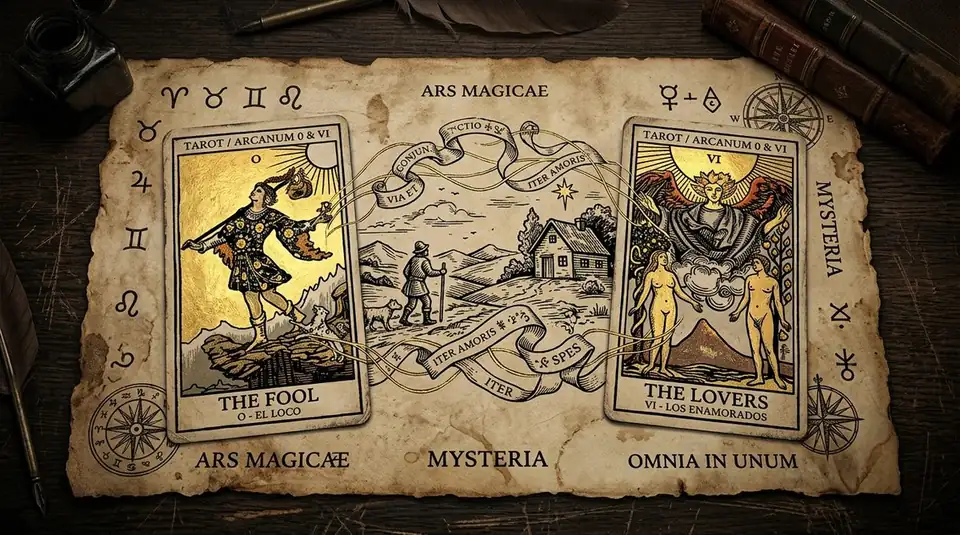
The defining test of a tarot reader does not occur when examining a single card in isolation. It happens when two, three, or five cards are laid out together. Beginners often treat a three-card spread like a grocery list, reciting three disconnected definitions separated by clumsy conjunctions: "Card one means new beginnings, AND card two means conflict, AND card three means financial gain." The client leaves the table bewildered, wondering how these three contradictory realities can possibly coexist in the same life.
In The Tarot Codex, Codex VII, The Tarot Combination Method, teaches that a tarot spread is not a list of separate nouns; it is a single living sentence. Just as words in spoken language modify, intensify, qualify, or cancel one another based on syntax, tarot cards in proximity enter into an active dynamic relationship. To read combinations with mastery, you must learn to identify the four primary modes of card interaction.
The Four Modes of Card Interaction
1. Reinforcement (Amplification)
When two cards share the same element, similar numerical stages, or harmonious archetypal themes, they double down on the message, intensifying the volume of that specific reality.
- Example: Three of Swords + Five of Cups. Air meets Water in shared grief. The sharp mental realization of loss in the Three is mirrored by the emotional weeping over spilled vessels in the Five. This is not a split message; it is a profound, unambiguous declaration of active mourning and sorrow that cannot be bypassed.
- Example: Ace of Wands + The Magician. Double Fire and focused will. Pure creative potential meets the technical capability to manifest it. The momentum is unstoppable.
2. Modification (The Adjective and the Noun)
In most combinations, one card acts as the primary subject or core situation (the noun), while an adjacent card acts as the modifier (the adjective or adverb), altering the flavor, speed, or tone of the event.
- Example: The Empress + Knight of Swords. The Empress is fertile, slow, somatic incubation. The Knight of Swords is razor-sharp mental velocity and aggressive pursuit. When placed together, the Knight modifies the Empress: the creative project is no longer leisurely incubating; it is undergoing aggressive, critical, fast-paced editing and rapid execution.
- Example: Ten of Pentacles + Four of Cups. Stable family legacy meets emotional apathy. The material castle is fully built, but the figure inside sits bored under a tree, taking the abundance for granted.
3. Contradiction and Paradox (The Friction Pair)
When two cards represent diametrically opposed forces, they describe an acute internal conflict or external impasse. Rather than seeing this as an error in the reading, the skilled reader identifies the exact nature of the tension.
- Example: The Chariot + Four of Swords. Complete forward kinetic velocity paired with horizontal, immobile convalescence in a stone tomb. This pair describes a person whose conscious ego desperately wants to charge forward, while their exhausted body or nervous system is demanding an immediate, non-negotiable shutdown.
- Example: The Devil + The Star. Toxic material bondage sitting next to pristine spiritual liberation. The client is standing right at the threshold of release, acutely aware of the addiction or obsession that still holds them captive.
4. Narrative Sequence (Cause, Action, and Resolution)
Cards often arrange themselves into a cause-and-effect progression, telling a story across time or consciousness.
- Example: Tower ➔ Star ➔ Sun. The classic redemption arc. Sudden, shocking dismantling of the false ego structure (Tower) clears the sky for quiet spiritual renewal, healing, and faith (Star), which ultimately blossoms into joyful vitality, wholeness, and public success (Sun).
The "Single Sentence" Method
As detailed in our dedicated guide on how to turn tarot cards into one sentence, you should never leave a combination without synthesizing it into one clean, spoken statement. Use this three-step formula:
- Identify the Anchor Card: Which card carries the heaviest archetypal weight (usually a Major Arcana card or a court card)?
- Trace the Directional Flow: Where is the energy moving? Look at the gaze of the figures and the elemental interactions.
- Form the Sentence: State what is happening, what is modifying it, and where the tension resolves.
When you master combinations, the deck stops speaking in disjointed fragments and begins conversing with the clarity and authority of an open book.
Before combining cards, it is worth confirming that you can read one on its own. A single-card yes/no draw strips away every relational cue described above and leaves nothing but the scene itself — which is precisely why it exposes whichever habits you are still quietly relying on.