
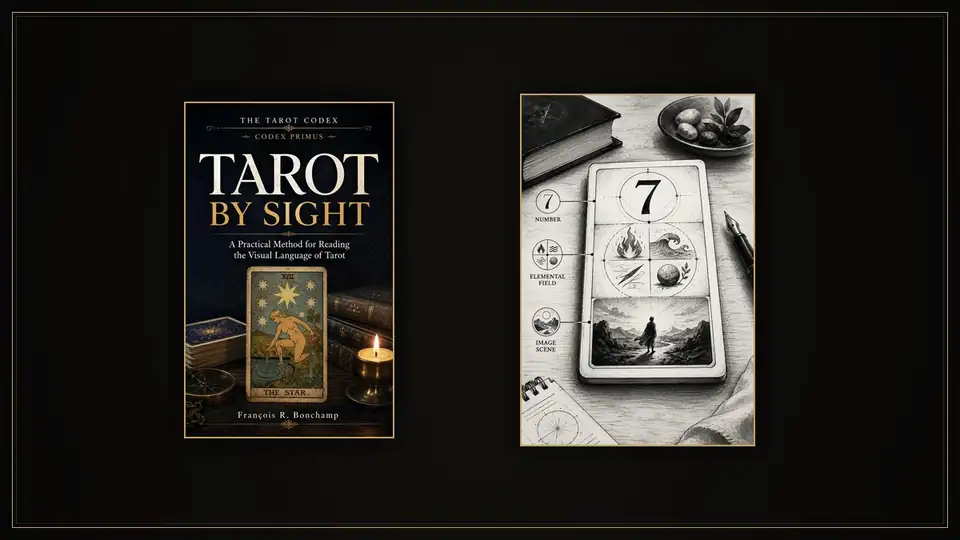
What truly distinguishes a seasoned, professional tarot practitioner from an enthusiastic hobbyist? It is rarely the number of decks they own, the esoteric books they have read, or how many obscure astrological correspondences they can rattle off from memory. The real distinction lies in their cognitive architecture—how their mind processes visual information, frames human questions, and navigates the delicate psychological dynamics across the reading table.
In The Tarot Codex, François R. Bonchamp outlines the disciplines that transform tarot from an eccentric parlor game into a serious instrument of self-reflection, philosophical inquiry, and practical counseling. Professional readers do not see themselves as theatrical fortune-tellers dispensing unavoidable prophecies. They operate as disciplined interpreters of visual evidence, helping clients make sense of their choices, recognize blind spots, and reclaim personal agency.
The Five Cognitive Disciplines of the Master Reader
1. Observation Precedes Interpretation
The novice looks at a card and immediately runs their mind through a catalog of memorized meanings. The professional does something far simpler and infinitely more disciplined: they look at what is actually in front of them.
- They notice the physical posture of the figures: Are they leaning forward, collapsing, or standing guard?
- They notice the lines of sight: Is the Queen looking at the adjacent card or turning away in disdain?
- They audit the elemental weather: Are there zero Cups on the table? Is the spread entirely arid and fiery?
By rooting the interpretation in empirical visual facts, the professional never gets lost in vague abstractions. They can point directly to the card and show the client why they are saying what they are saying.
2. Rigorous Question Reframing
Amateur readers passively accept whatever question the client blurts out, even when the question is disempowering, voyeuristic, or fatalistic (e.g., "Will my ex call me tonight?" or "Is my coworker out to get me?"). An expert reader knows that a poor question guarantees a confusing reading.
Before a single card is drawn, the professional helps the client reframe the inquiry from passive fate to active responsibility:
- From: "Will my business fail?"
- To: "What operational blind spots am I ignoring, and what must I restructure to ensure long-term stability?"
- From: "Does he still love me?"
- To: "What emotional dynamics are currently operating between us, and what truth am I hesitating to acknowledge?"
3. Synthesizing Spreads into Unified Sentences
As taught in Codex VII, The Tarot Combination Method, an expert never delivers a disjointed laundry list of card definitions. They synthesize the entire layout into a coherent narrative arc. They understand how adjacent cards modify each other, where the primary tension lies, and how the cards resolve. The client does not leave with five confusing puzzle pieces; they leave with a clear, resonant narrative.
4. Ethical Humility and the Rejection of Fatalism
The hallmark of an amateur is theatrical certainty: proclaiming inevitable divorces, imminent windfalls, or fatal curses. Such claims inflict psychological harm and rob the client of agency. Professional readers practice rigorous ethical containment:
- They never predict physical illness, death, or severe medical outcomes (they refer to qualified healthcare professionals).
- They never claim to read the private minds of third parties without their knowledge or presence.
- They present the cards as probabilities, tendencies, and mirrors of current momentum—momentum that can always be altered by conscious human choice.
5. Holding Somatic and Emotional Space
A tarot reading is rarely an intellectual exercise; it is an intimate encounter where clients frequently reveal profound grief, unexpressed desires, career anxiety, and relationship heartbreak. A master reader does not flinch, judge, or rush to offer glib platitudes.
They maintain grounded somatic presence, listen deeply to what is left unsaid, and use the symbolic language of the deck to give the client a safe, dignified vocabulary for their deepest human experience.
The first of these disciplines — refusing to accept a vague question — is also the easiest to rehearse alone. Long before a client sits down, practise narrowing a question until one card could honestly answer it. A free one-card yes, no, or not yet reading will accept anything you type, which makes it an unusually honest mirror for how loosely most questions are actually phrased.