
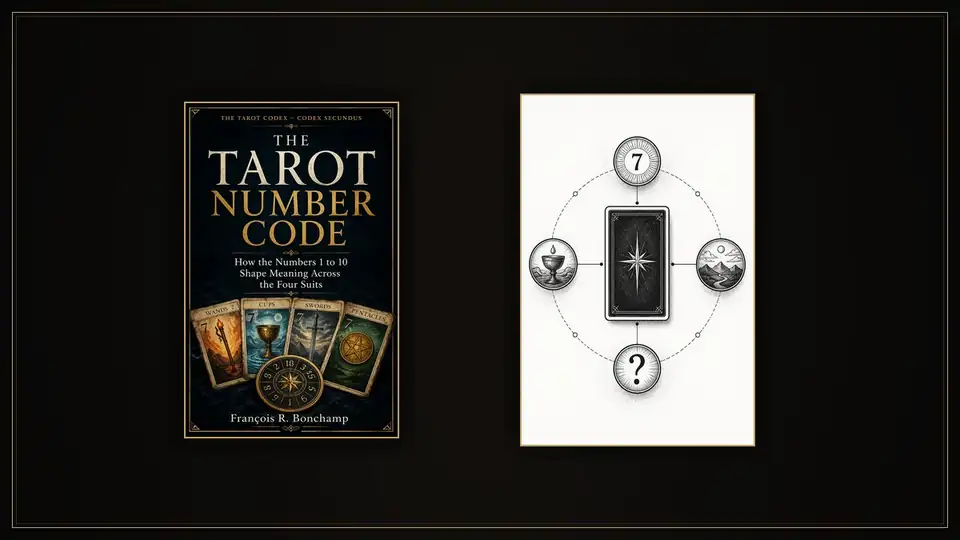
To the untrained eye, the forty numbered cards of the Minor Arcana can feel like an overwhelming catalog of arbitrary scenes: a youth standing with seven staves, five swords resting in a tomb, three pentacles carved into a stone cathedral arch. Readers often exhaust themselves trying to memorize forty disconnected vignettes. Yet behind every single numbered card lies a rigorous mathematical and philosophical architecture: the universal logic of numbers from One to Ten.
In The Tarot Codex, particularly within Codex II, The Tarot Number Code, we teach that a numbered card is a simple mathematical equation: Number + Suit = Situation. The suit provides the physical and psychological arena (action, emotion, intellect, or material reality). The number dictates the exact stage of development within that arena. Once you grasp how numbers progress from inception to culmination, you can read any Minor Arcana card instantly—even in an unfamiliar deck.
The Developmental Arc: From One to Ten
The sequence from Ace to Ten is not a random collection of moments; it mirrors the universal lifecycle of any project, relationship, idea, or endeavor:
Ace (The Seed of Pure Potential)
The Ace is the element in its unmanifest, concentrated form. There is no human figure operating the tool—only a divine or mysterious hand emerging from a cloud. An Ace is not an achievement; it is an invitation, an raw pulse of energy waiting for human agency to give it shape.
Two (Polarity, Contemplation, and Choice)
When unity divides, polarity emerges. The Two introduces dualism: self and other, give and take, crossroads and balance. In the Two of Wands, we survey the horizon; in the Two of Cups, we exchange vows; in the Two of Swords, we weigh decisions in blind stillness; in the Two of Pentacles, we balance fluctuating resources.
Three (First Materialization and Expression)
Two forces combine to generate a third. Three is the first visible fruit of collaboration or growth. It brings celebration and community in Cups, initial trade and mastery in Pentacles, creative expansion in Wands, and the acute realization of heartbreak in Swords.
Four (Stability, Boundary, and Container)
The square, the table, the foundation. Four halts movement in order to build shelter. It offers safety, structure, and order, but carries the inherent danger of stagnation, stubbornness, and complacency. In the Four of Cups, contentment risks turning into boredom; in the Four of Pentacles, security curdles into possessiveness.
Five (Crisis, Rupture, and Instability)
Five disrupts the comfortable box of the Four. It introduces friction, loss, challenge, and the necessity of growth. Fives test whether the foundation of the Four was real or merely brittle. Without the Five, evolution ceases.
Six (Restoration, Harmony, and Equilibrium)
Following the crisis of the Five, Six arrives to restore balance. It represents triumph in Wands, sweet reconciliation and memory in Cups, safe transit across rough waters in Swords, and reciprocal generosity in Pentacles. It is harmony won through endurance.
Seven (Assessment, Strategy, and the Inner Test)
Seven breaks outward harmony to ask: Is this path truly sustainable? It is the number of individual examination, moral challenge, and long-range strategy. In Wands, we defend our ground alone; in Cups, we confront illusions; in Swords, we act with stealth; in Pentacles, we lean on a hoe and evaluate the crop.
Eight (Rhythm, Velocity, and Refinement)
Eight represents the mastery of energy through discipline or inescapable momentum. It is the swift flight of Wands, the deliberate walk away from old cups, the mental entrapment of Swords, and the focused chisel work of Pentacles. Eight demands rigorous alignment.
Nine (Near-Completion and Culmination)
Nine brings the journey to its highest personal peak. The individual stands alone with what they have created, endured, or feared. It is solitary fulfillment (Nine of Cups), resilient vigilance (Nine of Wands), nocturnal anguish (Nine of Swords), or private material abundance (Nine of Pentacles).
Ten (Excess, Exhaustion, and Threshold of Renewal)
Ten is the container overflowing. It represents the absolute conclusion of a cycle, where quantity transforms into a new quality. In the Ten of Wands, carrying too much leads to collapse; in the Ten of Swords, the mental ordeal is completely finished; in Cups and Pentacles, joy and wealth expand to embrace the entire family or community.
The Dynamic Between Odd and Even Numbers
Notice the structural rhythm: Even numbers (2, 4, 6, 8, 10) are inherently stable, receptive, structured, and balancing. They represent consolidation and partnership. Odd numbers (1, 3, 5, 7, 9) are dynamic, destabilizing, driving, and seeking. They represent hunger, crisis, innovation, and movement. When a spread is dominated by odd numbers, the client's life is in active agitation; when dominated by evens, the situation is settling into established patterns.
Reading Number Repetition Across a Spread
When multiple cards of the same number appear in a single layout, the numerological frequency drowns out individual card variations:
- Multiple Aces: Powerful fresh beginnings, simultaneous breakthroughs across multiple life domains.
- Multiple Fours: Resistance to change, excessive consolidation, or craving for absolute control.
- Multiple Fives: Widespread volatility, acute transition, structural upheaval testing core beliefs.
- Multiple Tens: The definitive closing of an entire chapter of life, exhaustion of old systems, impending rebirth.
By rooting your interpretation in number first, you establish a solid framework that anchors every symbolic detail of the reading.
Number is also the fastest way into a single-card draw, where there is no spread to lean on. Pull a one-card yes or no reading and read the number before the picture: an Ace and a Ten may both point in a positive direction, but one is an opening and the other a closing, and the advice that follows from each is entirely different.