
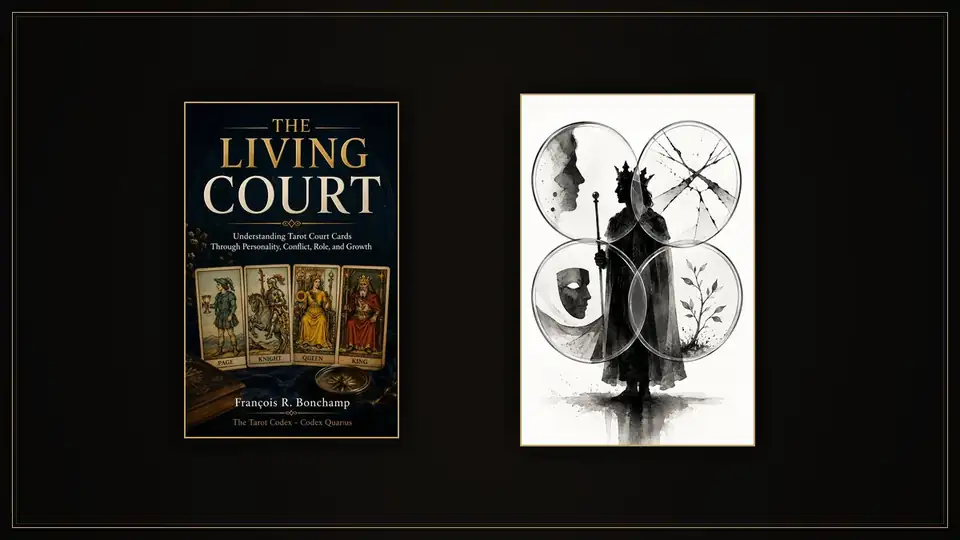
Ask a dozen tarot readers which cards cause the most hesitation in a reading, and eleven will give the same answer: the Court Cards. For over a century, popular tarot books have taught readers to treat the sixteen court figures as rigid Myers-Briggs personality types or literal astrological caricatures: the Queen of Wands as an extroverted Aries woman, the Knight of Pentacles as a dependable Taurus farmer, or the Page of Cups as a shy Pisces youth. When real readings take place, these narrow personality boxes instantly fall apart.
In The Tarot Codex, particularly in Codex IV, The Living Court, we dismantle this reductionist approach. A court card is not a flat character sketch; it is an active pattern of behavior, a psychological role, and a specific stage of human maturity. Furthermore, a court card does not always represent an external person in the querent’s life. Very often, it portrays a sub-personality, a defense mechanism, an emergent capacity, or a behavioral stance the querent is actively enacting.
The Structural Architecture: Rank as Mode of Expression
To read court cards cleanly, you must separate Rank from Suit. The suit tells you the terrain (Fire, Water, Air, or Earth). The rank tells you how consciousness relates to that terrain:
1. Pages (The Novice: Curiosity, Reception, and Potential)
Pages are students, apprentices, and messengers. They stand on solid ground, looking with wonder or fascination at the symbol of their suit. A Page has not yet mastered their element; they are discovering its properties. They represent the spark of fresh curiosity, experimentation, but also the vulnerability of inexperience.
- Psychological state: Willingness to learn, beginner’s mind, receptivity, curiosity.
- Shadow expression: Immaturity, gossip, scattered attention, unwillingness to take responsibility.
2. Knights (The Agent: Velocity, Pursuit, and Mission)
Knights are mounted on horseback. They are the only rank depicted in active transit. While Pages contemplate their suit, Knights weaponize it and ride into the world to pursue a goal. A Knight represents focused intention, but also the tunnel vision of fanaticism. They lack the containment of the Queen and the systemic vision of the King.
- Psychological state: Drive, ambition, advocacy, urgency, devotion to a cause.
- Shadow expression: Impatience, aggression, recklessness, running over others in pursuit of the objective.
3. Queens (The Vessel: Interior Mastery, Containment, and Cultivation)
Queens are seated on stone thrones, deeply integrated with the landscape. While Knights charge outward, Queens draw the element inward to cultivate, sustain, and embody it. A Queen does not need to chase her element; she has become it. She rules through emotional intelligence, presence, discernment, and internal depth.
- Psychological state: Deep emotional maturity, containment, intuition, capacity to nurture growth.
- Shadow expression: Emotional manipulation, smothering control, bitterness, cold withdrawal.
4. Kings (The Sovereign: Governance, Structure, and Authority)
Kings rule the external manifestation of the element. Seated firmly with royal regalia, they are responsible for creating systems, setting ethical standards, defending territories, and dispensing justice. The King represents the element in its institutional, public, and executive maturity.
- Psychological state: Leadership, executive discipline, long-range responsibility, strategic command.
- Shadow expression: Tyranny, dogmatic rigidity, emotional detachment, abuse of institutional power.
The Four Ways to Interpret a Court Card in Context
When a court card appears on the table, do not guess whether it is a person or a trait. Use this systematic four-part checklist to let the question and context decide:
- As an External Person: Is there someone in the client's immediate environment who embodies this exact rank and element (e.g., an impulsive Knight of Swords manager, or a nurturing Queen of Pentacles mentor)?
- As a Role or Stance: What behavioral posture is the situation requiring? (e.g., "In this negotiation, you must embody the King of Swords: dispassionate, precise, bound by contracts, leaving emotion aside.")
- As an Inner Part: Which internal psychological complex is being activated? (e.g., the insecure Page of Wands longing for validation, or the hyper-vigilant Queen of Swords guarding old heartbreak).
- As an Event or Atmosphere: Occasionally, particularly with Pages and Knights, the card represents an incoming message, proposal, sudden conflict, or rapid change in tempo.
Reading Court Figures Through Body Language
As detailed in Codex VIII, The Body Language of Tarot, the posture of a court figure reveals everything about their inner state. Compare the Knight of Swords (leaning far forward over his galloping horse, sword thrusting directly ahead into gale-force winds) with the Knight of Pentacles (sitting completely motionless on a heavy plow horse, calmly holding a single gold coin in his palm). One is aerodynamic velocity; the other is enduring gravity. When you observe how the body carries the element, memorized keywords become unnecessary.